Stinging insect and hornet removal in Columbus requires mechanical containment rather than arbitrary broad-spectrum pesticide broadcast. In established architectural pockets like German Village and Victorian Village,…
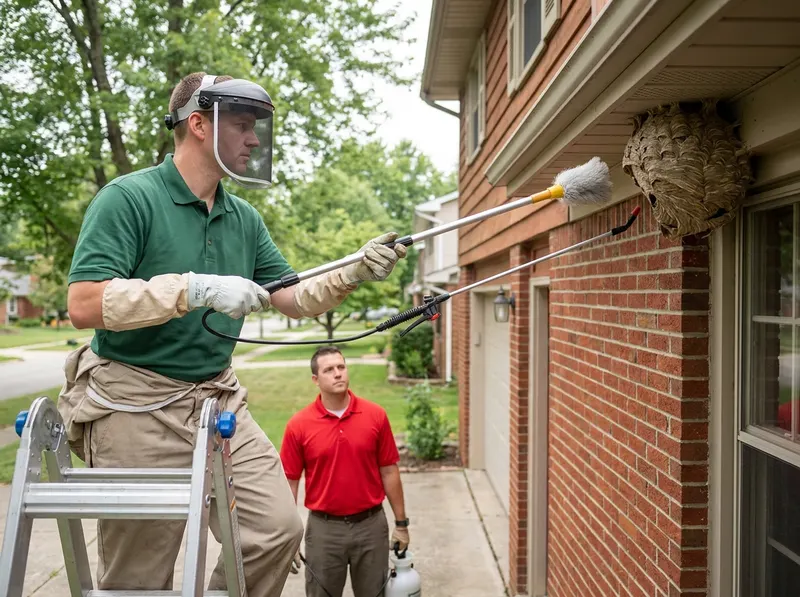
Stinging insect and hornet removal in Columbus requires mechanical containment rather than arbitrary broad-spectrum pesticide broadcast. In established architectural pockets like German Village and Victorian Village, mature colonies frequently occupy unvented soffit voids, brick weep holes, and decorative cornice returns. A mature bald-faced hornet (Dolichovespula maculata) colony often contains 400 to 700 workers by late August, constructing dense cellulose nests that deteriorate drywall when moisture accumulates. TerraBloom Extermination employs thermal imaging sensors and targeted Integrated Pest Management (IPM) protocols supported by the Ohio State University Department of Entomology, ensuring active colonies are systematically intercepted without introducing neurotoxic synthetic pyrethroids into indoor air channels.
Subterranean yellowjacket nests (Vespula vulgaris) present acute hazards along the porous limestone garden beds of Grandview Heights, Bexley, and Clintonville. Soil-nesting workers excavate abandoned rodent burrows, expanding populations up to 4,000 individuals before autumn frost cycles. Standard surface dusting fails because nesting combs curve downward up to 36 inches below turf grade. Technicians deploy closed-loop, HEPA-filtered vacuum extraction compliant with OSHA respiratory protection guidelines, capturing foraging adults before administering botanical pyrethrin derivatives sourced from Chrysanthemum cinerariifolium blooms directly into the primary subterranean portal. For structures bordering urban tree canopies near Goodale Park, Franklin Park Conservatory, or the Olentangy River corridor in Worthington Hills, aerial European hornets (Vespa crabro) often hollow out decayed tree cavities or external wall insulation, mandating controlled night extractions when worker flight ceases.
Structural eradication requires a calibrated four-stage execution sequence:
Choosing targeted physical extraction over retail chemical aerosols prevents indoor colony displacement. Unregulated retail freeze sprays often aggravate hornets, driving panicked workers inward through recessed lighting fixtures, electrical faceplates, and baseboard gaps into living areas. Commercial biological exclusion balances non-target pollinator preservation, monitored by the Ohio Department of Agriculture Apiary Program and the Xerces Society for Invertebrate Conservation, with immediate human safety. Structural integrity remains secured under continuous residential compliance standards defined by the U.S. Department of Housing and Urban Development and building envelope specifications from the International Code Council.
Every job gets a firm, written price after an on-site visit.
Tell us about your stinging insect and hornet removal job in Columbus and we'll send a clear, written quote, usually the same day.
 TerraBloom Extermination